Приказивање постова са ознаком According to Science. Прикажи све постове

четвртак, 9. мај 2019.

These Are the Best Sleeping Positions for Your Health, According to Science

Sleep

How do you sleep?

Tossing and turning until the wee hours of the morning should be the exception, not the rule. But if you’re among the 50 to 70 million American adults who suffer from sleep or wakefulness disorders,  you’re all too familiar with this nightly routine. While it’s tempting to blame your mattress for your troublesome sleep problems, the real culprit might be you’re not dozing off in the best sleeping position, experts say. Science says some sleeping positions will not only help you get a better night’s rest but also prevent health problems. And it could take just one simple tweak to discover the secret to a better night’s snooze.

The worst sleeping position

It may be a good position for skydiving, but lying spread-eagle on your stomach is not the best sleeping position, the National Sleep Foundation says. While sleeping on your stomach might help alleviate snoring, it can pressure on your muscles and joints and cause aches, irritated nerves, and numbness.  According to WebMD,  sleeping on your stomach can also strain the lower back and neck, and your back, which could actually make snoring worse. To avoid this, prop your forehead on a pillow to allow room to breathe while sleeping face down.

Luckily, only about seven percent of adults default to sleeping on their stomach. Health advantages (and disadvantages!) aside, you might be curious to learn what your sleep position reveals about your personality.

The best sleeping position for you

The best sleeping position for you may depend on any preexisting health conditions. “The best position to sleep in is likely on one’s side,” says Brian Koo, MD, a Yale Medicine neurologist and sleep specialist, who is the director of the Restless Legs Syndrome Program. Sleep apnea and snoring become worse when one sleeps [on their back]. If there is no snoring in the supine position, then sleeping supine is okay.”

If you’re not a snorer, sleeping on your back also works well, according to the National Sleep Foundation. Though only eight percent of people sleep on their back, doing so takes pressure off your head, neck, and spine. If your head is properly elevated, it can also help prevent acid reflux. Make sure your mattress supports your preferred sleeping position to further help your health and your ability to get a good night’s rest.

How to best sleep on your side

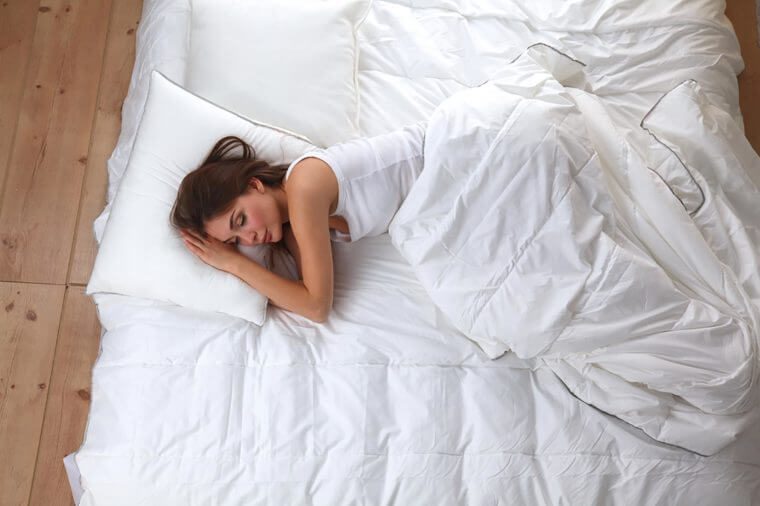
Most adults sleep in a fetal position, according to the National Sleep Foundation. If this is your preferred position, there are ways you can doze off on your side and make it the best sleeping position for your health.  Curling up too tightly can restrict breathing and leave your joints sore. You can improve this by straightening out your body as much as possible and placing a pillow between your knees to prevent strain on your hips. Koo recommends not sleeping with your head on your arm or hands because it can cause nerve damage.

For most people, the healthiest way to sleep is on your left side, curling your legs and placing a pillow between your knees. This position can ease any back pain and prevent loud snoring, according to Dr. Josh Axe. He says it can also help acid reflux. The National Sleep Foundation says it’s also the best choice for people with sleep apnea, though it can lead to wrinkles since half your face is pushing against a pillow. Not suffering from any of those ailments? These are the best sleep positions for every health problem.


The post These Are the Best Sleeping Positions for Your Health, According to Science appeared first on Reader's Digest.


from Reader's Digest http://bit.ly/2VfVZIm
These Are the Best Sleeping Positions for Your Health, According to Science Reader's Digest

четвртак, 31. август 2017.

This Is the Best Time to Exercise to Improve Your Memory, According to Science

This-Is-the-Best-Time-to-Exercise-to-Improve-Your-Memory_567493819_Dean-Drobot

Cramming for a big exam, or memorizing a Powerpoint for that important board presentation? Take a quick study break and hit the gym, science says.

No, seriously! According to a new study published in the journal Cognitive Research: Principles and Implications, just five minutes of light physical exercise after any learning session can give your memory a boost. (You should also memorize these everyday habits of people with impressive memory.)

Researchers from the University of New South Wales in Sydney, Australia, led by Dr. Steven Most, conducted four experiments that included a total of over 250 undergraduate participants. They aimed to test the students’ memories before and after five minutes of exercise.

Through all four of the experiments, an interesting pattern emerged. Researchers noticed that women who performed a mild physical activity after learning something scored higher on memory tests than the women who did not exercise. What’s more, exercise was most effective at boosting memory when participants did so after the learning session. Here’s how you can boost your memory with music and meditation, too.

However, the same trend did not apply to the male participants. Dr. Most speculates that this might have to do with the facial recognition test that the experiments used to score memory levels, which only included male faces. If females respond better to male faces, their reactions might have swayed the results.

“It’s unclear whether this is a true sex difference or whether there was something about the experiment conditions that allowed the effect to emerge among women and not men,” Dr. Most said.

Of course, more research will be needed in the future to determine with certainty that exercise has a positive impact on memory. But this isn’t the first study to make the connection between exercise and memory; in fact, plenty of research indicates that physical activity can reinforce learning. All the more reason to start lacing up your sneakers.

One does not live by physical exercise alone, though. These are the best brain exercises to improve your memory.

[Source: Medical News Today]


from Health – Reader's Digest http://bit.ly/2vvElIK
This Is the Best Time to Exercise to Improve Your Memory, According to Science Health – Reader's Digest

четвртак, 6. јул 2017.

This Is the Secret to a Picture-Perfect Smile, According to Science

We all have our own idea of what the perfect smile should look like, whether we show a mouthful of pearly whites or keep our lips closed and turned up at the corners just so. While there are many good reasons to get grinning—including the incredible health benefits of smiling, new research suggests that there really is a proper way to smile, and it has everything to do with facial expression.

When we think of the perfect smile, we often envision a wide, beaming grin, with all of our teeth showing, but based on new findings, less is actually more. For the open-access journal, PLOS ONE, Nathaniel Helwig and his colleagues at the University of Minnesota discovered that a successful, genuine smile actually rests less on showing teeth and more on facial balance and symmetry, Science Daily reports.

Scientists-Discover-the-Secret-to-a-Perfect-Smile

For the study, researchers looked at 3D computer-animated facial models of more than 800 study participants. The computer-animated facial models underwent a series of facial transformations, with researchers changing the mouth angle, amount of teeth shown, the extent of the smile, and how symmetrical the smile was. Participants were then asked to rate the models’ smiles based on effectiveness, genuineness, pleasantness, and perceived emotional intent.

The results of the study found that the most successful smile—one that was rated most pleasant, genuine, and effective—had a perfect balance of teeth, an ideal mouth angle, and a smile length that extended to what was dubbed the “sweet spot.” Smiles that demonstrated a quick sync of the left and right side of the face during smiling were also more highly related.

The fact that the smile models were computer-generated shouldn’t take away from the results, as previous studies have found that studying electronic facial models can be a great asset in researching “how changes in expression over space and time affect how people read faces,” the study co-authors told Science Daily. They believe that “using 3D computer animation may help to develop a more complete spatiotemporal understanding of our emotional perceptions of facial expression. Since some people have medical conditions such as stroke which hinder facial expressions, with possible psychological and social consequences, these results could also inform current medical practices for facial reanimation surgery and rehabilitation.”

As Science Daily notes, smiling makes up a good portion of our nonverbal communication, making it important to have a grin that will draw people to you and also seem sincere. It’s also worth noting that perfect smile could help improve your health too.


from Health – Reader's Digest http://bit.ly/2tW838w
This Is the Secret to a Picture-Perfect Smile, According to Science Health – Reader's Digest