понедељак, 6. мај 2019.

6 Measles Symptoms You Should Know—Even if You Were Vaccinated

Close up doctor's hand injecting for vaccination in the shoulder woman patient.Vaccine for protection concept.

Measles might not seem relevant, especially for people with the vaccine. But between January and April of 2019, America saw the highest reports of measles cases since the disease was “eliminated” in 2000, according to the Centers for Disease Control and Prevention (CDC). More than 700 measles cases in 22 states mean there is more curiosity and concern about measles symptoms, what the measles rash looks like, and vaccine policies. Here’s everything you need to know about the disease.

What are measles?

Measles is a highly contagious viral illness that’ll occur in 90 percent of exposed individuals, according to Bruce Polsky, MD, the Chairman of the Department of Medicine at NYU Winthrop Hospital, an infectious disease specialist. Doctors don’t over exaggerate about the measles. The virus hangs in the air for up to two hours—even after the infected person leaves the area, says John T. Raffalli, MD, FACP, a CareMount Medical Infectious Disease specialist. Here are more details on the recent measles outbreak.

What are measles symptoms?

Measles typically start with cold-like symptoms including:

  • Fever
  • Runny nose
  • Cough
  • Conjunctivitis (red eyes)
  • Koplik (tiny white spots on the mouth)
  • Fatigue or discomfort

These signs and symptoms appear two to four days before the rash, Dr. Polsky says, and up to three weeks after the initial exposure to the virus, per Dr. Raffalli. All of these symptoms, including the rash, work from the top of the body down. This includes a sore throat and a cough that might persist for one or two weeks after recovering from other symptoms, according to Dr. Polsky. If left untreated, more serious complications of measles include permanent brain damage, pneumonia, and middle ear damage, Dr. Raffalli adds, hence the creation of the vaccine (more on that later.)

What does the measles rash look like?

Are-Measles-Coming-Back--What-You-Need-to-Know

The measles rash is extremely red and blotchy. It first appears on the face, spreading downward and outward on the body to the neck, hands, and feet. If someone with measles has this rash, they are contagious via coughing and sneezing from four days before the rash appears to four days after, says Dr. Raffalli. Recognize the difference between the measles rash and 14 of the most common skin irritations.

How effective is the measles vaccine?

The global total of measles deaths decreased by 84 percent between 2000 and 2016 thanks to the measles vaccine, according to Dr. Polsky. That’s because developing the measles is rare in someone with the full vaccination—two doses of the vaccine, Dr. Polsky adds. People have the first dose between 12 and 18 months old, and the second booster between six and seven years old, Dr. Polsky says. “If you’ve only received the first dose of the vaccine, the estimated protection level is 93 percent,” he says. “We need community levels of immunity of 95 percent or greater in order to provide the ‘umbrella’ of protection that interrupts transmission.” That’s why the second shot became a staple after 1989, according to Dana Hawkinson, MD, an infectious disease specialist at The University of Kansas Health System.

Who is most at risk of measles?

The people who are most at risk for contracting the virus are those without the vaccine, such as children under one, and people who might only have one dose of the current vaccine (since doctors only began recommending the two treatments in 1989), Dr. Hawkinson says. So people with older vaccinations may need the second booster shot, which you can determine with the help of your doctor, Dr. Polsky says. People born before 1957, however, are generally considered immune as the disease was still prevalent in America during this time, before the vaccine era, according to Dr. Hawkinson. You can protect yourself against the next viral outbreak by following these 9 expert recommendations.

If you have the measles vaccine, can you still contract the virus?

There are some rare cases of contracting the virus is you have the vaccine, according to Caesar Djavaherian, an emergency medicine MD, and co-founder and Chief Medical Director at Carbon Health. “We aren’t exactly sure why, but some theories include the possibility of a subpar immune response to the vaccines to confer full immunity,” Dr. Djavaherian says. This means people with the full vaccine who still get measles might have immune systems that didn’t respond as they should have to the vaccine, per the CDC. “However, those who have been vaccinated who get measles are much more likely to have a milder illness and are less likely to spread the disease to those who are unvaccinated including young children and babies,” Dr. Djavaherian notes. In most cases, someone who has the measles vaccine shouldn’t worry, and a simple blood test can determine your immunity, Dr. Polsky adds.

So it won’t hurt for people who have both doses of the vaccine to keep an eye out for measles symptoms as both doses of the vaccine provide 97 percent—not 100 percent—protection, Dr. Polsky says. Still, Dr. Hawkinson says vaccine immunity lasts a long time. “We have a safe, effective vaccine to use to prevent measles, mumps, and rubella, two other viral illnesses,” Dr. Hawkinson says. “The most important thing you can do to keep yourself and loved ones safe is get vaccinated.” Although the vaccine is quite effective, vaccines are still one of the 11 biggest health controversies of all time.

The post 6 Measles Symptoms You Should Know—Even if You Were Vaccinated appeared first on Reader's Digest.


from Reader's Digest http://bit.ly/300sQ7B
6 Measles Symptoms You Should Know—Even if You Were Vaccinated Reader's Digest

Meghan Markle’s Skin Care Routine Is Surprisingly Easy to Follow

Meghan Duchess of Sussex

The Duchess of Sussex always looks vibrant, glowy, and blemish-free whether she’s at a black tie event or just traveled halfway around the globe. And while you might believe her skin care routine is a complex thing, her beauty regime is just as easy to follow as her diet. We got the dish straight from Sarah Champman, London’s most sought after facialist, who has exclusively looked after Meghan’s skin care since she moved to the United Kingdom. Sarah spills her tips for achieving a picture-perfect complexion at home.

Work it out

At the Saraph Chapman clinic, her “Signature Bespoke Facial” reigns supreme. This, her most popular treatment, is completely personalized for clients like Meghan Markle (and a laundry list of other celebs like Victoria and David Beckham), but what all the appointments have in common is Chapman’s award-winning ‘gymnastics’ face massage techniques. During these appointments, the Duchess of Sussex’s face is massaged using light but firm pressure.

“My number one tip for giving an instant glow back to the skin is facial massage,” Chapman says. “Not only do the movements help to stimulate lymphatic drainage on puffy complexions, promoting a healthier-functioning dermis for improved cellular activity and better-looking skin, but massaging your skincare products deeper into the skin will also help to boost their performance,” she concludes. She suggests using your knuckles and fingertips for an at-home facial experience that mimics her clinical, signature “gymnastics” techniques. You can also use her Facialift massage tool, designed to recreate Sarah’s lifting, firming, and rejuvenating movements effortlessly.

Incredibly easy to recreate, this skin workout will have you looking like royalty in no time. Check out Meghan’s own stunning transformation since moving to the United Kingdom.

Three additional steps to princess-worthy skin

Chapman also advocates for a three-step process of cleansing and applying serum and moisturizer in addition to massaging. “Thorough cleansing can turn people’s skin around,” says Chapman. “Spending a few minutes each day really working with your cleanser to create a clean and fresh canvas will not only improve the look of your skin but also its function.” Even if life gets hectic and you find yourself in a huge rush, Sarah says “cleansing is absolutely non-negotiable!”

As for the serum, your choice should be tailored to your specific skin concern, Chapman suggests. Use one of the best serums for every skin type. “The essential final step is a moisturizer to lock in hydration and create healthier functioning skin,” Chapman says. Start by determining the best moisturizer for your skin type.

It’s not just Meghan Markle’s skin care regimen that’s easy-to-follow, it’s her head-to-toe regimen, which includes these 13 products under $20.

The post Meghan Markle’s Skin Care Routine Is Surprisingly Easy to Follow appeared first on Reader's Digest.


from Reader's Digest http://bit.ly/2V41I46
Meghan Markle’s Skin Care Routine Is Surprisingly Easy to Follow Reader's Digest

четвртак, 2. мај 2019.

My Childhood Illness Came Back After 16 Years—And Almost Killed Me

I was 20 years old, studying abroad in Spain in the midst of my junior year of college, when I almost died. No one could figure out why I couldn’t breathe—I was on my own. I realized it was up to me to survive.

A couple of weeks earlier, my only feelings were excitement and joy that I was going on a 29-day trip to Spain. Then, on Christmas Day in Seville, I left my host family’s home to go for a 30-minute walk along a beautiful bike path. It wasn’t too hot, yet I felt winded and my face was on fire. By the time I got back to my host family’s house, I was completely out of breath and my heart was racing. After ascending the several flights of stairs to my room, I collapsed on the hardwood floor, grasping at my throat and chest in an attempt to remove what felt like a hand squeezing my airway shut. I couldn’t tell whether it was anxiety or something physically wrong that was robbing me of air. I didn’t even have enough air to call for help.

I started chanting a mantra as I pressed my cheek to the cold floor, hoping that a trace of oxygen would slip through the strawlike opening in my throat. I began repeating to myself, “You are strong and you are calm,” over and over again until I started to get more air into my lungs. Realizing that fear and helplessness were taking over, I used the mantra to establish control. I pledged that anxiety would not win this battle. I began taking small breaths: inhaling, 1, 2; exhaling, 1, 2 (something I’ve learned from yoga).

An hour later, I regained somewhat of a normal breathing rhythm, enough to call my translator and ask for help. After a steroid shot in the butt, an overdose from an inhaler, and a chest X-ray, all the doctor could tell me was, “Tienes bronquitis” (“You have bronchitis”). All I could think was that there’s no way bronchitis prompts that kind of reaction.

I wouldn’t learn until nearly three months later, back in the United States, that I had experienced a severe asthma attack. My mother remembered that I had it as an infant; a doctor confirmed that the asthma had returned.

Looking back on that day, I have no idea how I was able to stay calm, but my reaction saved my life. Giving in to anxiety would have further tightened my airways; by integrating my yoga breathing exercises, I got through. It’s a lesson I carry with me through life: Relax, don’t give in to fear, and just breathe.

You can use these 11 tips for managing anxiety and panic disorders, to help manage your breathing if you’re ever in a similar situation.

The post My Childhood Illness Came Back After 16 Years—And Almost Killed Me appeared first on Reader's Digest.


from Reader's Digest http://bit.ly/2PPsAmU
My Childhood Illness Came Back After 16 Years—And Almost Killed Me Reader's Digest

среда, 1. мај 2019.

16 Signs Your Face Is Aging Faster Than You Are

You’ve got sun spots

closeup of a woman cheek with liver spot causes by the large exposition sun Skin aging is going to happen—but lifestyle and environmental factors can make you appear older than you are. For example, you know the sun can harm your skin, but this damage can actually age your skin’s appearance with unsightly brown patches. “As we enter our 30s, we begin to see the cumulative impact of sun damage, including sun spots,” says dermatologist Whitney Bowe, MD, author of The Beauty of Dirty Skin. “Much of the damage that causes sun spots is UV-induced, but hormones can fuel spots and splotches too.” She advises addressing the dark spots with a serum containing botanical brighteners, like licorice, soy, arbutin, and niacinamide; or talk to your dermatologist about the prescription bleaching cream hydroquinone. Here are more weird ways the sun affects your body.
The post 16 Signs Your Face Is Aging Faster Than You Are appeared first on Reader's Digest.


from Reader's Digest http://bit.ly/2HtjFTj
16 Signs Your Face Is Aging Faster Than You Are Reader's Digest

How to Identify Bed Bug Bites—and How to Treat Them

bed bug bites how to identify and treat

Unfortunately, a bed bug bite has no telltale sign, according to a review published in the American Society for Microbiology. The reaction to bites varies tremendously from one person to the next. Some people will have no reaction or just minor itching and mosquito-like bumps in one area; others will get dramatic red raised welts all over. “It depends on the number of feeding bugs on the body, how long the person has been suffering bites, and also where the bites are located,” says Jody Green, PhD, an urban entomologist at the University of Nebraska-Lincoln.

Five stages of post-bed bug bites

If you have evidence of bed bug bites on your skin, it’s due to your body’s allergic response, according to the U.S. Armed Forces’ 2019 Pest Management Board: Technical Guide #44. That response can take a few different forms: little to no reaction; an immediate reaction—often a red spot with minor discomfort; a delayed reaction in which red weals turn up within 14 days that trigger intense itching that can last two to five days; or, unfairly, a combination of immediate and delayed reactions. This makes it tough to know what’s gnawing on you without the help of an entomologist or dermatologist. Although this guide to bug bites may help.

Familiar signs of bed bug bites

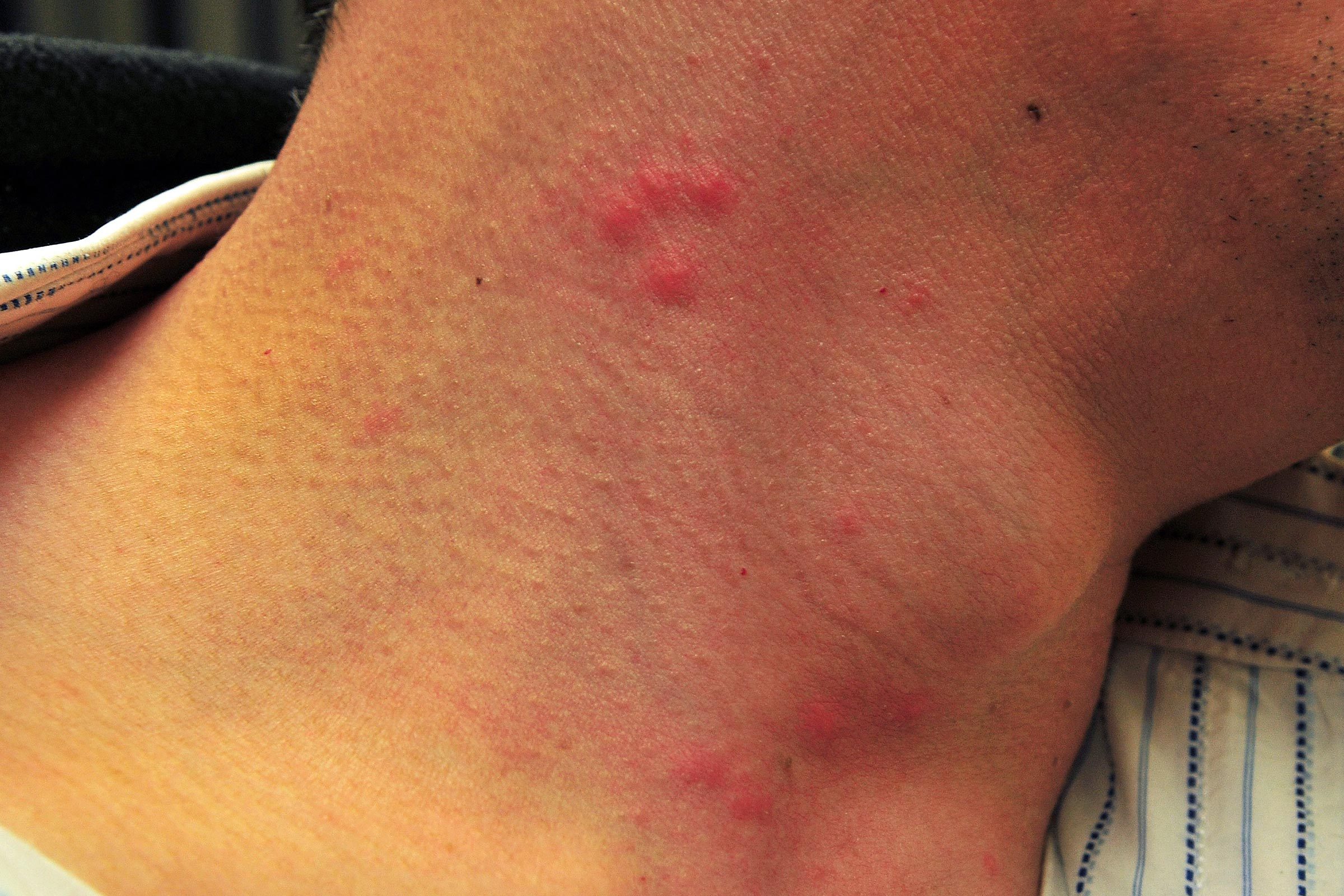
While there is no exact way to tell what bug bit you, dermatologist A. Yasmine Kirkorian, MD, an assistant professor of Dermatology & Pediatrics, Children’s National Health System, says there are some patterns doctors look for: “Bed bugs typically bite several times in a row so people may notice several red itchy bumps grouped closely together, a pattern sometimes called ‘breakfast, lunch, and dinner,'” she explains. “They can occur anywhere on the body; bed bug bites on the face may cause intense swelling including of the eyelid.” A small study found that 72 percent of people who were bitten by bed bugs had itchy red welts, 50 percent had redness or discoloration, and 28 percent had itching with no welts. Call your doc or dermatologist and look for these signs of bed bugs in your house.

It can’t be bed bug bites

Let’s say you are sleeping in the same bed as your partner and your partner wakes up with bites but you don’t. Must not be bed bugs, right? Sadly, it still could be. “The most challenging thing about bed bug bites is that there is are people who do not react to bed bug bites, so they have no adverse skin responses and have no idea that they are being fed upon while they are sleeping,” says Green. One survey found that nearly one in three people had no reaction to bed bug bites. When the researchers broke out reactions by age, they found that 42 percent of people over 65 had no reaction. Bites or no bites, this is how bed bugs could get in your bedroom.

Bed bug bite treatment

People who do react to bed bugs often have intense itching. “Once a patient has been bitten, it is difficult to eradicate the itching. Over-the-counter anti-itch creams that contain one percent pramoxine can help,” says Dr. Kirkorian. Try Aveeno with pramoxine and calamine. Oral antihistamines such as Zyrtec and Benadryl may be effective too, says Dr. Kirkorian. But if your itching persists, your dermatologist or doctor might prescribe topical steroids such as triamcinolone and fluocinonide.

Just thinking about bed bugs can wreck your sleep, as well. Talk to your doctor if you start suffering from insomnia. “A sedating antihistamine such as Benadryl could be safe to use,” says Dr. Kirkorian.

Home remedies for bed bug bites

Before you commit to natural bed bug treatment, remember to practice good hygiene and caution, advises Larry Bishop, MD, a dermatologist with Health First Medical Group: Be sure to wash the area with soap and water first to reduce the risk of infection; if the area appears irritated or develops a rash, stop using the treatment and see a doctor. For remedies, Dr. Bishop suggests trying peppermint oil: “It works by two mechanisms—the peppermint oil is a vasoconstrictor (blood vessel constrictor), which lessens the pain and irritation from bed bug bites. Additionally, the peppermint works as a soothing agent by gently stimulating the nerves around the bite.” Try adding a few drops to a warm bath; if you want to apply it to the bites, dilute it first with an oil such as coconut, jojoba or olive.

Lemon balm is another favorite for bug bites. Crush or roll the leaves with your fingers to release the juice, apply it to the bites, and wrap with a bandage. “It works by having soothing properties and antibacterial properties,” Dr. Bishop says. Finally, there’s household ammonia—research suggests that it can help with itchy bites. It may not smell great, says Dr. Bishop, but if you put a little on a cotton ball and dab it on the area right away, it can help. “It works by neutralizing the proteins that are in the saliva of the bed bugs.” The saliva is what produces the allergic reaction in some people, and the quicker you neutralize it, the better.

When to see the doctor

Your bed bug bites will generally clear up on their own, but if you itch them the scratching can lead to secondary infections. “The initial bite may be a portal for bacteria to enter the skin. If a patient develops a worsening red bump, pus drainage, a fever, or other signs of systemic illness, they should seek urgent medical attention,” advises Dr. Kirkorian. Then, find out how to get rid of bed bugs.

The post How to Identify Bed Bug Bites—and How to Treat Them appeared first on Reader's Digest.


from Reader's Digest http://bit.ly/2Lgytv9
How to Identify Bed Bug Bites—and How to Treat Them Reader's Digest

Nothing Stopped My Severe Migraines Until I Dropped This One Food from My Diet

woman migraine headache pain

If there had been a hidden camera videoing my migraines, it would have captured a woman in her 30s, writhing on the living room floor of her apartment while trying desperately—and weirdly—to massage the pain out of her shoulders and head. Sometimes I’d knead with my hands, occasionally with massage devices, and once in a while with the handle of a purple hairbrush. Then you’d see me run to the bathroom, where I’d clear out on both ends, and then I’d return to the floor. Repeat, repeat, repeat. It would last about four to six hours—and happen around four times a month. It was a mystery—check out these 12 reasons you might get migraines.

At that point I was otherwise pretty healthy—I did yoga and meditated, I drank mostly enough water, ate a fairly balanced, mostly organic diet—not too much sugar or processed foods. To stop the migraine monster from visiting, I tried acupuncture, massage, hypnosis. I kept a food diary to search for “triggers.” I studied my menstrual cycle to see how it corresponded with my migraines. I popped magnesium supplements. I stewed stinky Chinese herbs. Nothing worked. Here are some migraine remedies you can try.

I finally accepted a prescription for Imitrex from my doc. If I took the migraine drug at the first inkling of a headache, I could shorten the stretch of misery—maybe I wouldn’t throw up, or I’d just feel nauseated for an hour or so. But each time the drug made me feel weird, like a pillow was expanding in my head and concrete was pouring into my stomach.

Finally, I went to a neurologist. She gave me pamphlets, an MRI, and then weekly mega doses of intravenous magnesium—but still no relief. Then, at 40, I got pregnant. My migraine monster, perhaps in deference to my state, disappeared. According to the American Migraine Foundation, 50 to 80 percent of women who suffer from migraines have fewer episodes during pregnancy, especially during the second and third trimesters when estrogen levels rise. I was free of them throughout my pregnancy.

A few weeks after my glorious baby boy arrived, my doula offered to watch him as I slipped out for a latté. I marveled at my freedom on the walk to the coffee shop I used to frequent. I ordered a regular latté, with regular, full-fat milk (I was breastfeeding—I needed the fat). The intense, velvety flavor was the caffeinated balm to my soul.

A few days later, a migraine struck: The first one was mild, the next more intense. The monster was back. I didn’t want to take meds because I was breastfeeding. So I suffered and nursed my fussy child. One day I opened his diaper and saw green. I Googled for an answer, and mom sites suggested it could be from me eating dairy.

When I checked with my pediatrician’s office, the nurse said crisply, “That’s a myth. Dairy doesn’t cause green poop. It’s a normal color.” Normal for some babies, but mine was super-cranky. And what about the other moms who’d said dairy was the thing?

I decided that if I was eating something that might be hurting my baby, I should try stopping. I switched to soy lattés, then quickly switched to no lattés (because they were awful). I stopped eating ice cream. I halted pizza and yogurt.

Something I’d read said it takes a while for the dairy to get out of the mom’s and baby’s systems. After about ten days, my baby’s poop was brown. He cried less, he slept better, he didn’t scrunch his face in what looked like pain. After about two weeks went by it hit me: I hadn’t had a migraine.

Nothing Stopped My Severe Migraines Until I Dropped This One Food from My Diet

Dietary migraine triggers can range from olives to alcohol to MSG: The American Migraine Foundation has a list of the main migraine triggers. I didn’t realize that I didn’t have to be allergic to something in a traditional fashion to have it cause migraines—and milk does not appear as an allergy for me in a pin-prick test. Also, I didn’t fully understand how triggers can work: For me, it meant I ate something bad, and three days later I’d get a migraine. Neurologist David Buchhholz, MD, of Johns Hopkins University, told NPR.org that the effects of a migraine food trigger can be delayed up to 72 hours.

Once I’d cleared dairy from my system, though, I did become more sensitive. Recently a restaurant made a mistake—broccoli raab cooked in butter, not oil—and I spent the night throwing up.

So, I abstain. I’m not naturally an abstainer. Rules make me itchy. But apparently, the agony of a migraine is motivation enough. So I’ve found “ice cream” I like too much—coconut-based Larry & Luna’s. I’ve semi-settled on oat milk for my coffee (it’s good but makes for a chalky latté). I get non-dairy pizza when I can. These are some more non-dairy food swaps I might try.

Truly, I miss good cheese. I haven’t found a substitute that doesn’t remind me of Play-Doh. I miss real, greasy, margarita pizza. I miss yogurt. I miss chocolate soft serve on warm summer nights. But I don’t miss being that woman writhing on the floor late into the night.

My best advice if you’re struggling with migraines? Find a doctor who will take your pain seriously and check you out fully. Then you can try an elimination diet, and start adding things back, one by one, to see if any trigger head troubles. But don’t stop looking for a cause—migraines can impact your life in numerous ways. While I might get the occasional tension headache, I don’t get migraines any more. And that’s even better than the best latté ever.

The post Nothing Stopped My Severe Migraines Until I Dropped This One Food from My Diet appeared first on Reader's Digest.


from Reader's Digest http://bit.ly/2VFXvYy
Nothing Stopped My Severe Migraines Until I Dropped This One Food from My Diet Reader's Digest

15 Things Brain Doctors Wish You Knew About Strokes

brain anatomical figure stethoscope

Younger people get strokes, too

Most people assume strokes typically happen to older people, but a report published in the Journal of the American Heart Association reveals there was a 44 percent increase among Americans between the ages of 25 and 44 in the past decade. “That’s why annual checkups, especially when you’re young, are so important, to see if you have any risk factors before they start creeping up on you,” says Salman Azhar, MD, Director of Stroke at Lenox Hill Hospital in New York City. Learn about the 14 stroke risk factors you can control.

Remember the “BE FAST” warning signs for stroke

If you’re experiencing any symptoms that fall under the “BE FAST” checklist, you should seek treatment immediately, says Osman Mir, MD, a neurologist at Baylor University Medical Center in Dallas, TX.

B: balance (loss of coordination)

E: eyes (blurred or loss of vision)

F: face (dropping of one side of the face)

A: arms (drifting, cannot raise both arms above head)

S: speech (sudden slurring)

T: time (call 911 immediately)

An easy way to identify a stroke

“People get caught up on particular symptoms of stroke, but really the main symptom is when anything that you were just doing seconds ago—picking up a cup of coffee, texting, or maybe waking up to find your leg is dragging for example—should be considered a warning sign of a stroke,” says Dr. Azhar.

A stroke doesn’t always cause pain

“A common misconception about stroke is that it’s accompanied by pain, particularly a headache,” advises Dr. Mir. “While a sudden onset headache is indeed a symptom of hemorrhagic stroke, 90 percent of strokes are ischemic in which pain, if any, is not as common of a symptom as motor or speech issues.”

Smart technology can help prevent stroke

“I’m a big fan of wearable technology—watches, pedometers—and I believe they can help prevent stroke,” says Dr. Azhar. Staying fit and keeping your blood pressure in a healthy range will lower your risk, he explains. “We have so many ways to measure our own health now, including smart scales that measure body fat and watches that measure blood sugar, and it’s helping people become more productive in being a partner in their health.”

brain scans

There are two main types of stroke

Ischemic strokes—they occur when a clot blocks a blood vessel to the brain—makeup 87 percent of all strokes, according to the Centers for Disease Control and Prevention. The other, lesser common type, is called hemorrhagic stroke; this is when a weakened blood vessel ruptures, and it’s most commonly caused by uncontrolled high blood pressure. If that sounds like a brain aneurysm, you’re not wrong—here are the differences between an aneurysm and a stroke.

New technology is helping early detection

“There’s so much more we can do now, versus five to 10 years ago, that we can do to prevent stroke,” says Dr. Azhar. For patients at risk, a small implantable chip called a loop recorder can monitor heart rate and rhythm: “This little chip gives doctors an early warning sign of abnormal rhythms which can triple the risk of a stroke. This allows us to make adjustments in medication.”

Deaths from stroke are declining

In the past 10 years, stroke has moved from the third highest cause of death to the fifth in the United States, reports Dr. Mir. “We think this is partly related to better control of blood pressure due to increased awareness, and cholesterol medications,” he says.

The treatment window is expanding

Experts once believed that the clot-busting medications known as tPA (tissue plasminogen activator) were only safe if patients got them within three hours of a stroke. But a 2015 study in The Lancet Neurology extended that window to 4.5 hours, and that means many more patients can benefit from these effective drugs. “Under very special circumstances, we can now even intervene on people who are coming in after that window,” says Dr. Mir. These IV drugs work by breaking up clots that are blocking blood flow to the brain; tPA is the only FDA-approved medication for acute ischemic stroke.

New procedures are helping more patients fully recover from stroke

Since 2015, surgeons have been able to use a special catheter and device to go in and physically grab the blood clots, says Justin Singer, MD, a neurosurgeon at Spectrum Health, Grand Rapids, MI. “The procedure is called emergent stroke thrombectomy, and it restores blood flow to normal. Our improved ability to quickly open blood vessels gives each patient a better opportunity to recover more fully and experience less permanent disability,” says Dr. Singer.

surgeons operating light

Sleep apnea is linked to stroke

“Most people know that factors such as diabetes, high blood pressure, heart disease, high cholesterol, and smoking clearly impact our risk for stroke. But many people don’t connect the dots when it comes to factors like sleep apnea, which can directly cause heart disease and then lead to stroke,” says Dr. Azhar. “That’s why I encourage those who experience sleep apnea to tell their doctor about it sooner rather than later, so we can do tests to identify your risk.” Watch out for these everyday things that can cause a stroke.

Exercise, diet, and stress-management the best protection

“Start paying attention to what you’re doing for your health every day,” advises Dr. Azhar. “Many times people think they need to drastically change things, but you can start with just five minutes on a treadmill, or go out and walk. Same goes for diet: Aim to eat a little bit better every day, and maybe that starts with eating a bit better at just one meal per day. It’s the idea of starting to change the practice from not thinking about what we’re eating, how we’re managing stress, and how much exercise we’re getting every day, and making slow and steady changes.” Discover the one fruit that will help you prevent stroke.

Don’t miss annual checkups

If you’re at elevated risk for a stroke—you have heart disease, diabetes, you’re a heavy drinker, a smoker, or there’s a history of stroke in your family (and that’s just a few of the risk factors)—you should get annual checkups, says Dr. Azhar. “Every year, you should be getting your inflammation levels checked with a blood test, as well as cholesterol, blood sugar, blood pressure, and percentage of body fat, to see what risk factors you have now and how you should adjust your life if necessary.”

Two million brain cells in 60 seconds

That’s how many brain cells you lose for every minute delay in restoring the blood flow to your brain, according to the experts at the University of Michigan. That’s why it’s still imperative to seek treatment ASAP. “There’s a general lack of awareness regarding the time sensitivity of stroke-like symptoms,” says Dr. Singer. “Frequently, patients will come to me after they have experienced symptoms for several hours or even days, and a significant amount of permanent damage to the brain has already been done; we’re not able to help them as much as we’d like.”

Women are at higher risk

You may think of stroke as a man’s disease, but in fact, women are more likely to suffer one. Every year, about 55,000 more women than men will have a stroke, according to experts at Harvard Medical School. Stroke is the third leading cause of death in women; it’s fifth in men. One reason for the disparity is that women typically live longer than men—increasing age is a stroke risk factor. But they’re also more susceptible to migraines, which can double risk. Female hormones, pregnancy, and childbirth all raise stroke risk as well. Women also have unique stroke symptoms that are easy to overlook.

The post 15 Things Brain Doctors Wish You Knew About Strokes appeared first on Reader's Digest.


from Reader's Digest http://bit.ly/2Lgyqzt
15 Things Brain Doctors Wish You Knew About Strokes Reader's Digest